COMMUNITY VOWS TO
SAVE
WARREN FREE HEALTH
CLINIC
By Cash Michaels
Staff reporter
The
Warren County Free Clinic, a vital resource for thousands of uninsured minimal-income
residents in Warren and Vance counties since 2006, is in trouble. Because of
state budget cuts, the clinic may have to drastically cut services, or worse,
close in several months, officials there say.
Currently,
the free clinic is operating five days a week, from 9 a.m. to 7 p.m., seeing on
average 25 patients a day. It has a patient-base (active and inactive) of 4,025,
with over 3,000 that are active. It is staff primarily with volunteers from the
medical community, faith-base organizations and local businesses, among others.
Low–income
residents receive services dealing with diabetes, high blood pressure and other
afflictions. They also get preventive care with clinical breast exams, pap
smears, once-a-month eye exams, AIDS virus testing, vitamin D12 testing, and instructions
to learn how to eat better.
The
free clinic was doing onsite lab testing before funding ran out.
“Most
of those served are not the Medicaid or “public assistance” population normally
thought of as needing help, instead, they are working persons with little or no
health insurance,” the clinic’s website states.
Warren County supplies the building
the clinic operates in for a nominal annual fee. Part of its funding comes from
various foundations, several local churches, Maria Parham Hospital through the
Duke Endowment, and a three-year grant from the Kate B. Reynolds Foundation.
The NC Association of Free Clinics
has also contributed.
But
if the free clinic does not get sufficient funding in the next sixty days, says
Daria Holcomb, co-founder and board secretary, its ability
to maintain its current level of services will be severely crippled.
“We’re
the number one provider of primary care for the uninsured in Warren County,”
Holcomb says.
The Republican-led North Carolina
General Assembly cut funding to the Office of Rural Health, affecting all rural
free clinics in the state, forcing them to now scramble to survive. The operational
budget for 2011 was $384,000, Mary Sommerville, the free clinic’s executive
director says.
“We were cut $150,000,” says
Sommerville.
And
they’re not allowed to apply for any federal grants, thus severely limiting
funding options.
If
funding isn’t restored to full level in 60 days, officials at the clinic say
services will either be cut back severely, or even worse, the clinic may not
operate at all.
Rev. Dr. Oris P. Fields, Jr. is
both a board member, and a patient of two years at the Warren County Free
Clinic. He says it’s a vital service to the community that must be saved
because “there are no medical facilities in the county.”
“Most
of the people, if they need medical care, have to go to Henderson, Duke
(Durham), Raleigh, or over to Roanoke Rapids,” Rev. Fields said, adding that if
the clinic were to close, he would personally have to wait a year to turn 65 so
that he could then take advantage of Medicare.
But
that would mean waiting a year to get the critical treatment that Rev. Fields
needs because he can’t afford the $90.00 per visit he would otherwise have to
pay to go elsewhere.
Fields
says there are Warren County residents who are younger – many of whom have lost
their jobs – who fall into the same category. With Warren County being one of
the state’s poorest, Rev. Fields says, “It’s a no-win situation.”
Because
of redistricting, the free clinic has lost Democratic state Sen. Doug Berger,
their strongest advocate. But Executive Director Mary Sommerville says its
board is planning various measures to publicize its plight, and seek public
support in having their budget cuts restored.
“The Free Clinic has tremendously improved the
health and well-being of many Warren County citizens due to greater
accessibility to critical outpatient health care services,” says Linda Worth,
Warren County manager.
-30-
NNPA STORIES -
http://www.nnpa.org/news/lead/leaders-craft-a-black-agenda-for-president-obama-by-freddie-allen/
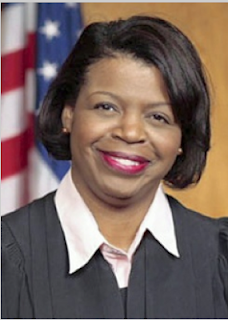 JUDGE CHERI BEASLEY
 FATHER PAUL MAYER
EXCLUSIVE

SIMMONS TWEETS FOR THE WILMINGTON TEN - Music mogul Russell Simmons (left), seen here sharing smiles with Wilmington Ten members Wayne Moore (center) and Dr. Benjamin Chavis at the hip Hop Summit at NC A&T University in 2008. Simmons sent out a tweet to his 2.2 million followers on Twitter last week, asking them to sign the NAACP petition asking Gov. Beverly Perdue to grant pardons to the Wilmington Ten [photo courtesy of Wayne Moore].

GOVERNOR APPOINTS BEASLEY TO
STATE SUPREME COURT
Gov. Bev Perdue Wednesday appointed
Cheri Beasley to the Supreme Court of North Carolina. Beasley, currently a
judge on the North Carolina Court of Appeals, will fill the vacancy created by
the retirement of Justice Patricia Timmons-Goodson.
“I am thrilled to appoint Cheri
to our state’s highest court.” said Gov. Perdue. “She has excelled both as a
District Court judge and as a judge on the Court of Appeals. She will make a
superb justice on the Supreme Court.”
Beasley was elected to the Court
of Appeals in 2008. Prior to that, she served as a District Court judge
in the Twelfth Judicial District from 1999 until 2008. Before going on the
bench, Beasley worked as an assistant public defender in Fayetteville for five
years.
“I am honored that Governor Perdue
has appointed me to serve as an associate justice on the Supreme Court of North
Carolina,” Beasley said. “I am grateful for her confidence in my ability to
render fair and impartial decisions while serving on our state’s highest
Court. Throughout my years of service on the judiciary, I have always
considered it a privilege to serve the people of our state.”
Beasley has been active in
numerous professional organizations, including the North Carolina Bar
Association, the American Bar Association, the North Carolina Association of
District Court Judges, the North Carolina Academy of Trial Lawyers, the North
Carolina Association of Women Attorneys, the Cumberland County Bar Association,
the Wake County Bar Association and Tenth Judicial District Bar, the Cumberland
County Association of Defense Attorneys, and the Fayetteville Bench and Bar.
She has also served as a lecturer in Appellate Advocacy and Trial Advocacy at
the University of North Carolina School of Law and the North Carolina Central
University School of Law.
Beasley received her law degree
from the University of Tennessee College of Law, and her undergraduate degree
from Rutgers University/Douglass College.
W-ed – SAD, SAD, SAD
As
the clock counts down to Gov. Beverly Perdue’s decision whether or not to grant
pardons of innocence to all of the Wilmington Ten – and we certainly hope she
does – we’ve been noticing something expected, yet peculiar.
The
more we make our case about the innocence of the ten civil rights activists who
were falsely tried, convicted and sent to prison for crimes they did not
commit, the more crazy people seem to come out of the woodwork.
For
instance, recently some group called “Citizens for Justice” put an ad in the
local newspaper asking “Gov. Purdue” not to pardon the Wilmington Ten. Then
they click off a number of reasons they don’t want to see it happen, none of
which speak to any credible evidence that any of the Wilmington Ten were guilty
of any crimes.
And
then they want someone to take a lie detector test, or something, to prove that
our evidence showing how prosecutor Jay Stroud tried to racially gerrymander
the jury was true.
These
“justice” folks apparently didn’t read the very newspaper they placed their
dumb ad in. Stroud has already admitted that the files we first exposed last
September are indeed his, and in his handwriting.
We
guess the folks who don’t even know how to spell the governor’s name didn’t
catch that article. And yet they know for a fact that the Wilmington Ten were,
are, and always will be guilty of crimes they did not commit.
Sad,
sad, sad.
Then
there’s that retired Wilmington police officer who “knows” exactly what
happened on the night of Feb. 6, 1971 – when Mike’s Grocery was firebombed –
even though the man didn’t join the Wilmington Police force until May 1971.
To
listen to this man, you’d have to believe that they did something wrong that
night, even if he can’t prove it. They had to have done something wrong. They
were following Ben Chavis. You know, that radical. How could we ever think
about pardoning people like this?
Oh,
and by the way. This retired cop “knows” that something is wrong with the
Stroud files. After all, the NAACP and that law professor from North Carolina
Central University is involved.
So
it must be phony.
Sad,
sad, sad.
And
please, let us not forget Mayor Bill Saffo.
This
is an elected official who attended the Feb. 3rd, 2011 event at
UNC-Wilmington commemorating the 40th anniversary of the Wilmington
Ten, made a quick speech where he openly apologized to the Wilmington Ten for
the injustice that they suffered at the hands of Wilmington police and the
judicial system; and then he read a proclamation denoting how the city should
learn the lessons of the Wilmington Ten.
Great
event! And great leadership as well.
Or
at least we thought.
When
the Wilmington Ten Pardons of Innocence Project included an unedited copy of
not just Mayor Saffo’s strong remarks, but also the entire memorable event on
DVD for the governor to see, along with the over 14,000 petition names, Saffo
objected, saying that the project was using his words “out of context.”
Saffo
says he wasn’t referencing the Wilmington Ten’s guilt or innocence. Only the
fact that they were sent to prison too long.
Not
that they were sent to prison at all, but rather that they had been imprisoned
for too long.
Talk
about sad…Mayor Saffo disappointed us greatly.
It
was sadly very apparent that Mayor Saffo had to squirm out of his own words. To
think that the mayor has had all of this time to refute his own words caught on
video, and reprinted in a daily newspaper for the world to see, and only now,
when the two-year old video is given to the governor as part of the pardons of
innocence project, does Saffo get cold feet, and starts doing a reverse
moonwalk away from his own words.
Yes,
Mayor Saffo is sad, sad, SAD!
You’re
starting to see all of this weak opposition to justice for the Wilmington Ten
because our supporters, particularly Rev. William Barber of the NCNAACP, have
been making the case that what happened to the Wilmington Ten forty years ago
was a travesty of justice.
People
don’t want to hear that. They want blood for the violence that ensued on
Wilmington’s streets. They want someone to forever pay for it. Problem is they
arrested and framed the wrong someone’s.
So
we want to make clear to our community, readers and supporters – we are here to
stand for justice for the Wilmington Ten. Our evidence is powerful, and our
will is unbending. Forty years of suffering must cease for the Wilmington Ten.
Four of them have died. Three of the remaining six are in ill health.
We
are too close to the goal, too close to changing history.
We
know that Almighty GOD is with us in this effort, and anyone who doesn’t
understand that…well we only have three words for you.
Sad,
sad, sad!
-30-
STATE NEWS BRIEFS –
12-12-12
NC HOUSE SPEAKER
CONFIRMS VOTER ID AT TOP OF LIST
[WILMINGTON]
When the GOP-dominated NC General Assembly convenes in January, House Speaker
Thom Tillis confirms that one of the very first measures lawmakers will tackle
will be instituting a new voter ID law. Outgoing Gov. Beverly Perdue vetoed the
last law requiring a photo identification at the polls passed by Republican
lawmakers. Now that Republican Gov.-elect Pat McCrory will take over January 1st,
Tillis is assuring GOP supporters that the Legislature will quickly pass one
now, and McCrory will sign it.
FAYETTEVILLE STATE
UNIVERSITY GETS $100,000 SCHOLARSHIP DONATION
[FAYETTEVILLE]
Fayetteville State University has received a $100,000 donation from the
Smithfield – Lusker Foundation for student scholarships at the historically
black university. The scholarships are for the children and grandchildren of
Smithfield Foods employees who also attend FSU. A spokesperson for the company
says it’s important for private industry to support higher public education.
NC DEMOCRATIC PARTY
CHAIR DAVID PARKER IS STEPPING DOWN
[RALEIGH]
David Parker, the embattled chairman of the NC Democratic Party, has announced
that he will not run for re-election next February. “I have enjoyed my two years of service to
our State and to the Democratic Party. There is much work to be done on
the vital issues of good government, public education and job creation in North
Carolina and I look forward to continuing to work to better our State in the
years to come," Parker said in a statement Wednesday.
-30-
TRIANGLE NEWS BRIEFS – 12-12-12
WAKE SCHOOL BOARD ADOPTS 2013-14 STUDENT
ASSIGNMENT PLAN
The
Wake County Board of Education, by a 5-4 Democrat-led vote, adopted a new
student assignment plan for the 2013-14 school year this week.
Under the plan, every student will be assigned to a school
based on his or her home address. To offer continued stability for families,
the plan includes minimal reassignments, as well as the opportunity for
students to stay with their current schools if they are happy there. The plan
offers sibling priority and families also will have options for
traditional-calendar schools and year-round schools.
Any student who enrolls in WCPSS for
the first time, or moves from another Wake County address will be assigned to a
school based on this new assignment plan. Updated maps and an address look-up
tool will be available soon for parents to preview their base school
assignments.
SOUTHEAST
RALEIGH RESIDENTS TO KROGER – “DON’T GO!”
Over
100 Southeast Raleigh residents expressed their disgust Monday night at Martin
Street Baptist Church at the news that two Kroger Supermarkets in the community
will be shutting down in mid-January. The Ohio-based food chain announced last
month that the stores on Martin Luther King Blvd. and on New Bern Avenue were
losing money, and had to be closed. Residents took offense, saying that it was
because the area is predominately black. Others said it’s strictly a business
decision. Several grocery chains are being approached to fill the void. Elderly
shoppers say they will now have to travel farther to do their shopping.
REP.
HALL OF DURHAM NEW HOUSE MINORITY LEADER
Durham
NC House Rep. Larry Hall has been elected House Minority leader for the next
two years by the House Democratic Caucus, published reports say. Hall’s job
will be to effectively challenge the Republican House majority on policies
Democrats deem important to North Carolinians. Hall, 57, has been in the state
House since 2006. He has been caucus whip since 2009.
-30-

EXCLUSIVE
WHY THE WILMINGTON
TEN WERE
CALLED ‘POLITICAL
PRISONERS”
By Cash Michaels
Editor’s Note – This is Part 1 of two
exclusive interviews featuring the man who sparked the worldwide campaign to
free the Wilmington Ten from prison; and another whose life was threatened by
white supremacists forty years ago if he told the truth in court about the
Wilmington Ten.
This
week, Father Paul Mayer.
---------------------------------
They are two men of GOD, both
white, both of whom became deeply involved with the African-American community in
the civil rights movement of the sixties and seventies.
Their
paths would intersect at the case of the Wilmington Ten, and history records
their vital footprints in the forty-year struggle for justice for the ten
innocent civil rights activists.
Until now, and until this very
story, Father Paul Mayer, a veteran climate-peace-and Occupy Movement activist,
has never before identified himself as the author of the historic 1976 report
by Amnesty International (AI) that first declared the Wilmington Ten to be
“political prisoners.”
Indeed,
the authors of AI reports – the highly regarded, nongovernmental international
human rights organization based in London that chronicles human rights abuses
worldwide – are rarely identified for their own safety, making Fr. Mayer’s
first and exclusive recollections about his investigation – which he writes
about in his yet-to-be-published memoir, Wrestling
with Angels – and how he met Rev. Eugene Templeton, the white former pastor
of predominately-black Gregory Congregational Church in Wilmington – which was
at the center of the Wilmington Ten controversy – all the more compelling.
Mayer, an East Orange, NJ resident,
is a Catholic priest of 55 years who served as a Benedictine monk for 18 years.
He has traveled the world, advocating for the poor in Latin America; standing
against nuclear proliferation, and demanding equal rights for all global
citizens.
As a young child, Mayer fled Nazi
Germany with his parents as the Jews were being persecuted. As a result, the religious
leader has a particular disdain for injustice.
While in the seminary, Mayer
traveled to Selma, Alabama in 1965 to meet and march with civil rights leader
Dr. Martin Luther King, Jr. in his drive for voting rights.
“That
was a life-changing experience,” Mayer, 81, who has been a part of many of the
peace and social justice movements of the last half-century, including Occupy,
says today.
Fr. Mayer says he did not attend
any of the 1972 Wilmington Ten trial proceedings, instead following
developments from New York. However, when the Rev. Benjamin Chavis, a young,
veteran civil rights activist Mayer knew and had worked with in his association
with the United Church of Christ (UCC), and the rest of the Wilmington Ten, had
been falsely convicted of conspiracy in the 1971 firebombing of a white-owned
grocery store, the activist priest knew he had to get involved.
“The
outrageousness of this case really had an impact on me,” Fr. Mayer recalls. “I
saw such a perversion of justice. This was a case of Southern racism.”
Chavis
had been sent to Wilmington by the UCC in Feb. 1971 to assist black students
there who had boycotted New Hanover County public schools because of racial
discrimination. Racial violence ensued, though there is no evidence that Chavis
had anything to do with it.
In
fact, Rev. Chavis, an Oxford, NC native, was sent to ensure that the striking
black students, who were headquartered at Gregory Congregational Church, only
employed the late Dr. Martin Luther King, Jr.’s philosophy of nonviolent
confrontation with Wilmington’s white power structure over their grievances.
But
it wasn’t long before Chavis and the students became targets at the church,
with trucks of marauding members of a white supremacist group riding by
nightly, shooting at the church and surrounding black community.
Fr.
Mayer decided that he would investigate the Wilmington Ten case, and reached out
to Amnesty International to allow him to write a report.
Normally
AI would only assign investigators who lived outside of the country they were
reporting on, but in Paul Mayer’s case, AI made an exception, he says.
“I
think they respected my credentials and my history,” Fr. Mayer says.
Recalling
the AI process for vetting human rights abuse investigations as “excruciatingly
thorough and demanding.”
“They
take nothing for granted,” Mayer, who dealt directly with AI’s London
headquarters, said. “Being declared a “prisoner of conscience”(which, according
to AI, refers to anyone imprisoned because of their race, religious or
political views) is a big deal, a major step. And at that time, they were more
[stringent] than they are today.”
AI
issued a list of criteria Mayer had to follow during his probe, he recalls. Using
his people skills, the Catholic priest began months of intense examination of
the Wilmington Ten case.
Based
on his investigation, Mayer determined that the crux of North Carolina’s case
against Chavis and his nine co-defendants was that they were holed up in Pastor
Templeton’s Gregory Congregational Church in Wilmington, carrying out “an armed
struggle,” meaning, according to their charges, that they had weapons in that
church, and were firing them at firefighters and police personnel who were
responding to the firebombing of Mike’s Grocery on the night of February 6,
1971.
To
this day, Dr. Chavis and the surviving members of the Wilmington Ten deny the
charges. Several of the Ten, like Willie Earl Vereen, James McKoy and the late
Connie Tindall, say that in fact, they were nowhere near Gregory Church or
Mike’s Grocery at the time of the arson and sniper fire.
Mayer
knew that finding Rev. Templeton, who had gone into hiding for fear of his life
years after the convictions, was the key to determining the answer to the
burning question, “Did Ben Chavis and the black students who were under attack
at Gregory Church have guns there to fight back with?”
New
Hanover County prosecutor Jay Stroud maintained they did, and had Chavis and
company falsely convicted, and sentenced to a combined 282 years in prison,
some of which they all served.
One
of the reasons why Stroud was able to convict – beyond stacking the jury of ten
whites and two blacks in the second trial with “KKK and Uncle Tom-types,” in
addition to a pro-prosecution judge, Stroud’s own infamous notes showed forty
years later – is because the defense’s prime witness, Pastor Eugene Templeton,
was threatened by white supremacists and did not testify.
Templeton
was the best witness because he was in the church the entire week of the
conflict, especially the evening of Feb. 6th, 1971 when Mike’s Grocery
was firebombed. He knew who was there and who wasn’t. He knew where Ben Chavis
was the entire time and what he was doing.
The
fact that the lives of Templeton and his wife, Donna, had been threatened to
keep his testimony from being heard in court, was significant to Fr. Mayer.
He
had to find Rev. Templeton, and have him reveal what he wasn’t allowed to tell
a court of law when it counted the most.
After
months of searching, Mayer tracked Rev. Templeton down to Morristown, NJ,
serving as a hospital chaplain. And even after locating him, it would be weeks
before Templeton would return Mayer’s phone calls, and finally agreed, under
certain conditions (no tape recording being one) to share what would have been
his testimony years earlier.
“I
appealed to his conscience that this, perhaps, could save [the Wilmington
Ten’s] lives,” Mayer said, indicating that all of the defendants were still in
prison at the time.
“[Templeton]
was terrified, and when I met him, close to a year [after contacting him], he
was still a very frightened man. It took a lot of therapy on my part, and a lot
of counseling, and as we Christians say, fellowship, [to] convince him that I
was not a charlatan, and I was going to respect his confidentiality in whatever
form he wanted me to.”
Fr.
Mayer also told Templeton that his AI report designating the Wilmington ten as
political prisoners could lead to an international campaign for their freedom,
which is ultimately what happened.
Rev.
Templeton began to talk, and, according to Father Mayer, his most salient point
was that despite all of the violence happening outside of Gregory
Congregational Church that first week in February 1971, there were no guns
inside of his church, and no one was firing weapons from the church, as had been
alleged by state prosecutors.
Not
only was having guns there against all that Rev. Templeton believed in, but it
would have also been against the rules set down by Gregory Church’s Deacon
Board, which voted to allow the black students to use the church for their
rallies and classes.
If
anyone affiliated with the church knew of any weapons there, Chavis and the
students would have been kicked out immediately!
However,
the jury in the Wilmington Ten trial never heard any of that.
“[Rev.
Templeton was very clear on this point,” Fr. Mayer recalls. “He had no
doubt…these people had no guns.”
“That
completely destroys the state’s case against [the Wilmington Ten].”
Mayer
is convinced that Templeton’s testimony to him about there not being any
weapons, the “centerpiece” of his 30-page handwritten report, convinced the
officials at AI to publish Fr. Mayer’s findings in 1976, designating the
Wilmington Ten as “political prisoners.”
The
report, which sparked a worldwide campaign, embarrassed not only North Carolina,
but also then-President Jimmy Carter.
It
wasn’t long before fifty-five members of Congress urged the US Justice Dept. to
investigate. The CBS television newsmagazine “60 Minutes” did an hour-long
broadcast revealing that the evidence against the Wilmington Ten had been
fabricated, and the three state’s witnesses had committed perjury.
The
worldwide pressure for the convictions to be thrown out forced then NC Gov.
James B. Hunt to get on statewide television and announce that he would not
pardon the Wilmington Ten, but at least commute their sentences.
And
in December 1980, after several appeals in North Carolina courts failed, the US
Fourth Circuit Court of Appeals in Richmond, Va. – perhaps one of the most
conservative federal appellate courts in the nation thanks to NC Sen. Jesse
Helms – overturned all of the convictions of the Wilmington Ten, citing gross
prosecutorial misconduct.
The
Fourth Circuit effectively told North Carolina that if it had any real evidence
against the Ten, then to please commence with a third trial. If not, then
dismiss all charges.
But
nothing happened. The Fourth Circuit’s decision was never appealed to the US
Supreme Court; no third trial ever took place; and none of the charges were
ever dismissed, even thirty-two years later.
Today,
the man who started it all, Father Paul Mayer, says it’s time for North
Carolina to finally deal with the reality of the Wilmington Ten case, and the
injustice that has been forty years in the making.
He,
like many others across North Carolina and the nation, want Gov. Beverly Perdue
to take a hard, honest look at all that’s happened, and then do justice by
granting pardons of innocence to the Wilmington Ten.
“I
feel deeply about this,” Father Mayer said. “I give thanks to GOD that I was a
humble instrument. Even though it was years ago, I still feel that it was a
major racist miscarriage of justice, and these people were maligned, defamed,
and I’m sure it hurt their lives in many ways.”
“We
know that racism is alive and well in America, and [granting pardons of
innocence] would be a significant step in rectifying one more racist
miscarriage of justice,” Father Mayer said.
Dr.
Benjamin Chavis, who hasn’t seen Paul Mayer in many years, had kind words for
his friend.
“The Reverend Paul Mayer is a lifelong colleague in the civil
rights movement,” Dr. Chavis said in a statement. “Rev. Mayer's ministry
continues to provide the fulfillment of what it means to be an effective and
globally respected disciple of the God of equal justice and freedom for all
people. Rev. Mayer is a research scholar and a transformative social visionary.”
Next week in part 2, Rev. Eugene Templeton,
in his own words, about what really happened at his church almost forty-two
years ago.
-30-

SIMMONS TWEETS FOR THE WILMINGTON TEN - Music mogul Russell Simmons (left), seen here sharing smiles with Wilmington Ten members Wayne Moore (center) and Dr. Benjamin Chavis at the hip Hop Summit at NC A&T University in 2008. Simmons sent out a tweet to his 2.2 million followers on Twitter last week, asking them to sign the NAACP petition asking Gov. Beverly Perdue to grant pardons to the Wilmington Ten [photo courtesy of Wayne Moore].
CASH IN THE APPLE
By Cash Michaels
WILMINGTON
TEN PARDON UPDATE – As coordinator of the Wilmington
Ten Pardons of Innocence Project, please allow me to straighten out a few
misnomers.
A legal petition for the governor
to issue individual pardons of actual innocence to ALL of the Wilmington Ten
was submitted May 17th of this year to the Governor's Office of Executive
Clemency by two attorneys for the pardon project. Those attorneys met with the
governor's clemency staff two months ago to answer any legal questions they had
about the case. Those questions were answered and documentation provided as
requested.
Some say the Wilmington Ten were
"never proven" innocent. Well, they were never "proven"
guilty either, even though they were all convicted, and sentenced to 282 years
in prison. To this day, there isn't a shred of concrete evidence proving that
any of the Ten committed any of the crimes they were charged with (they weren't
tried on all of the charges they faced, charges, technically, that are still
pending 40 years later if the state wanted to go forward). NO guns, NO bullets,
NO physical evidence of ANY sort proving that ANY member of the Wilmington Ten
had ANYTHING to do with the firebombing of Mike's Grocery Store, or the sniper
fire on public safety personnel attending to the blaze, on the evening of Feb.
6th, 1971.
NOTHING!
You say there's been no proof that
they didn't do it. Well, let's see now...Willie
Earl Vereen and James McKoy were musicians playing a gig in Leland outside
of Wilmington the night of the firebombing. The late Connie Tindall was celebrating his birthday at a party at a club
clear across town.
Anne Shepard, the white female, was a woman of size, as her
daughter Judy Mack says, who
couldn't possibly escape notice if she were involved in the firebombing. And
there's no proof she even knew how to fire a rifle, let alone a gun.
And Ben Chavis was at Gregory
Congregational Church that evening, working with the white pastor of that
church at that time, Rev. Eugene Templeton, wetting washcloths and towels in
case the National Guard had stormed the church with tear gas so they could be
put over everyone's faces.
So here's the problem. Prosecutor Jay Stroud knew he had no
case, so he "employed " three black convicted felons to perjure themselves
on the stand as "witnesses," because without them, he had NOTHING! He
took care of them - a beach cottage, a woman, a mini-bike - it's all in their
letters and the US Fourth Circuit of Appeals decision.
Stroud also plots a mistrial when
he ended up with a jury of ten blacks and two whites for the first trial, and
indeed, gets "sick" to cause one. In jury selection, the prosecutor
writes down that he should "Stay away from black men," and that he's
looking for "KKK and Uncle Tom-type"
jurors. And he gets a judge, Martin, who broke so many rules to ensure the
Wilmington Ten were convicted, that even the 4th Circuit Court made note of his
behavior.
So when folks say that the
Wilmington Ten's convictions were overturned on a "technicality,"
they actually don't understand what they're talking about.
The Federal Appellate Court
overturned the convictions in 1980 because, after studying the court record for
the second trial, it determined not only wasn't there ANY credible evidence on
which to convict, but that the prosecutor (Stroud) hid exculpatory evidence
that proved his own witnesses were lying through their collective teeth, especially
since he was paying them.
They later went before a judge and
admitted they had committed perjury.
Let me put this another way - IF
STROUD HAD EVIDENCE BEYOND THREE LYING WITNESSES, THEN WHERE WAS IT?
The 4th Circuit, in its decision to
overturn, told the state of NC to either dismiss all charges against the
Wilmington Ten, or retry them if they have any evidence at all.
THE STATE CHOSE NOT TO DO ANYTHING
FOR THE PAST THIRTY-TWO YEARS. WHY, IF IT HAS REAL EVIDENCE?
And that's why, after Gov. Jim Hunt refused to pardon in 1977
(because at the time, the 4th Circuit hadn't ruled yet), he did commute the
W-Ten's sentences.
No other governor since then was
ever asked to pardon the Ten.
In 2011, the National
Newspaper Publishers Association voted to seek pardons of innocence for the
Wilmington Ten. They appointed me, at the recommendation of the
Wilmington Journal, to coordinate
the effort. I've researched this case like the back of my hand. I've
interviewed many people, and I've read almost everything that is credible about
this case.
In my considered opinion, pardons
of innocence, especially after forty years, is more than justified. Yes, there
were shootings, incidents of arson and violence during that faithful time in
1971. No argument. But WHERE is the solid evidence proving that any of the Ten
had a hand in ANY of it? And if prosecutor Stroud had evidence, then why did he
have to hire three lying witnesses to prove his case?
In this country, we pride ourselves
with having the “best” criminal justice system in the world. But when we
prosecute people with "evidence" we have to make up, we do that
system, our state and our nation, a gross disservice.
This pardons of innocence effort is
NOT about money. We have been working too, too hard to uncover the truth about
how the Wilmington Ten were framed, and garnering the support that we have from
across the nation. Clearing the names and reputations of the Ten has been our
ONLY concern and goal. If we achieve it, the attorneys will deal with what's
next, not us.
JUSTICE...that's what burns in our
hearts about this case. And the measure for REAL justice is being able to
accept the unvarnished truth about the framing and criminal justice persecution
of the Wilmington Ten.
We thank you for your support thus
far. The work is not over, however. As long as there is still time for Gov.
Perdue to make a decision, the Pardon Project and our supporters will continue
to build support.
We are also asking, for those individuals, churches or institutions
who wish to beyond just signing the petition, to send letters to Gov. Perdue
asking her to grant pardons of innocence to the Wilmington Ten by Dec. 15th.
Here is that address:
Hon.
Beverly Eaves Perdue
Governor of North Carolina
20301
Mail Service Center
Raleigh,
NC 27699-0301
If
you want more information about the Wilmington Ten Pardons of Innocence
Project, you can go to www.wilmingtonjournal.com or on Facebook
at https://www.facebook.com/TheWilmingtonTenPardonOfInnocenceProject.
Please, as we enter this holy season of Christmas, let us deliver
peace and justice to those who have been forty years denied.
As a black journalist, and a proud member of the community, after
forty long years, I’d like to see justice done for the Wilmington Ten.
I sincerely hope that you do too.
Thank you.
Make sure you tune in every Thursday afternoon at 4 p.m.
for my talk radio show, ''Make It Happen'' on Power 750 WAUG-AM, or online
at www.myWAUG.com.
And read more about my thoughts and opinions exclusively at my new blog, ‘The
Cash Roc” (http://thecashroc.blogspot.com/2011/01/cash-roc-begins.html).
I promise it will be interesting.
Cash in the Apple - honored as the Best Column Writing
of 2006 by the National Newspaper Publishers Association. Columnist Cash
Michaels was also honored by the NNPA for Best Feature Story Journalist of
2009, and was the recipient of the Raleigh-Apex NAACP’s President’s Award for
Media Excellence in Sept. 2011.
Until next week, keep a smile on your face, GOD in your
heart, and The Carolinian in your life. Bye, bye.
-30-

